
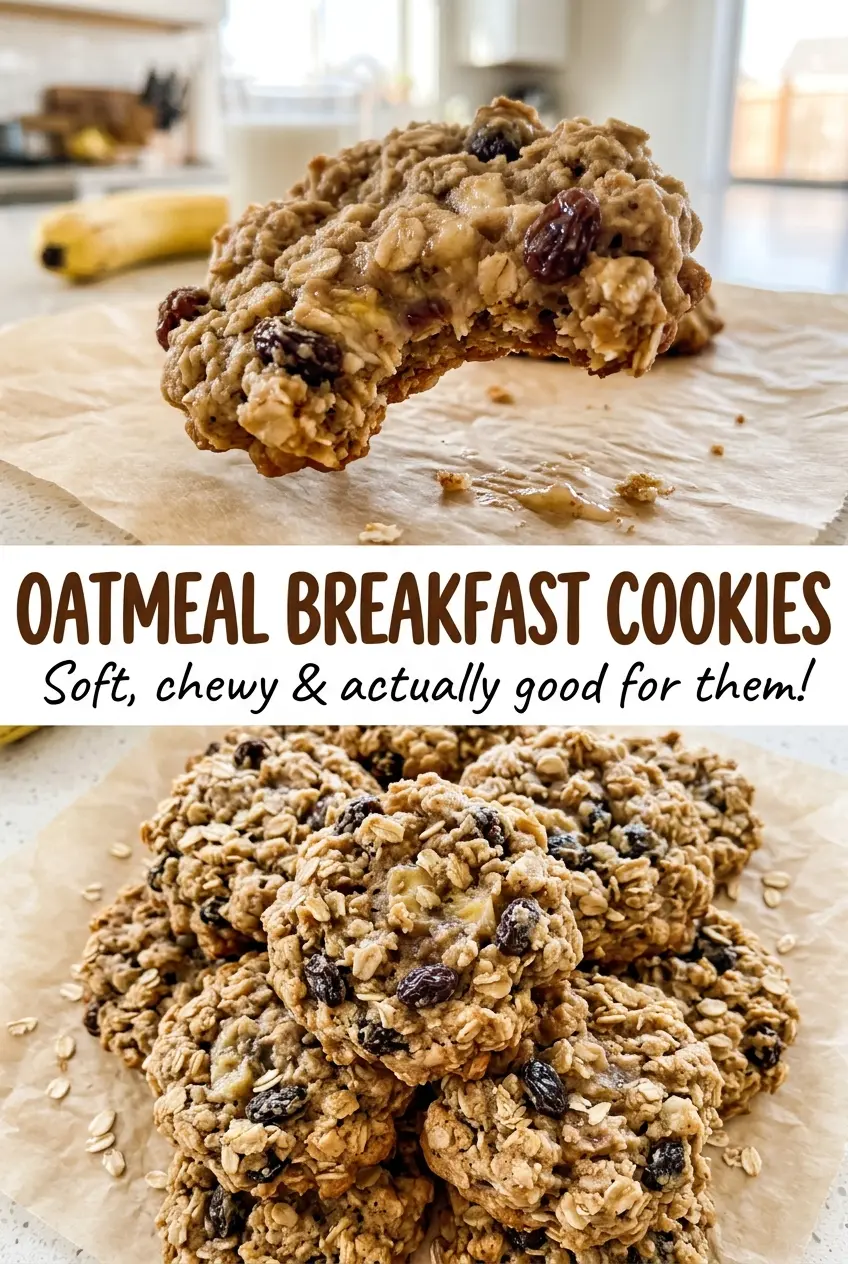
When the edges of an oatmeal cookie turn golden but the middle still looks a little soft, it can be hard to know whether to leave it in or pull it out. For these Oatmeal Breakfast Cookies, that small window matters: the edges finish baking on the hot sheet, and the centers firm as the cookies cool. I like that this dough gives you a classic chewy oatmeal-cookie texture without needing a mixer full of complicated steps.
The butter and brown sugar get beaten until creamy first, which gives the cookies a tender base for the oats, raisins, and walnuts. Then the flour goes in only until the dry streaks disappear; the oats and add-ins are folded through after that. With cinnamon in the dough and a little crunch from the walnuts, each cookie has a soft middle and plenty to bite into.
Kitchen Note
Give the cookies five minutes on the baking sheets before you move them. They’re fragile straight from the oven, and that short rest lets them firm up enough to transfer cleanly.
Save these Oatmeal Breakfast Cookies for a batch with cinnamon, chewy raisins, and crunchy walnuts in every bite.
Why These Oatmeal Cookies Need a Flour Base, Not Just More Oats
Oats make a cookie hearty, but they don’t do the same job as flour. Here, all-purpose flour gives the dough a structure that holds the raisins and walnuts together instead of letting the cookie bake into a loose pile of oats. The egg helps bind that structure, while butter and brown sugar make a dough that can be creamed and portioned like a cookie.
That balance is also why adding more oats to make the dough seem sturdier isn’t a good fix. Extra oats can soak up moisture and leave the cookies drier or more crumbly, rather than giving them better shape. The old-fashioned rolled oats already give each bite its chewy texture; the flour and the creamed butter mixture make sure there’s a cookie around them.
Think of the dough as a cookie dough with oats folded in, not an oat mixture that happens to be baked. That distinction keeps the texture tender and makes the raisins and walnuts feel like part of the cookie instead of loose add-ins.
What the Brown Sugar, Oats, and Add-Ins Bring to the Dough

- Light brown sugar — Its moisture and mild molasses flavor suit the chewy oatmeal-cookie texture. Pack it into the measuring cup so the amount is consistent; there’s no need to seek out a specialty brand.
- Unsalted butter — Softened butter creams smoothly with the sugar and makes a tender dough. Use butter that yields when pressed but isn’t oily or melted; the recipe’s separate salt lets the seasoning stay controlled.
- Old-fashioned rolled oats — These give the cookies their substantial, chewy bite. Quick oats break down differently, so they won’t give the same texture; use rolled oats for the result described here.
- Raisins — They bring concentrated sweetness and a chewy contrast to the oats. Separate any raisins that have stuck together before folding them through so they don’t go into the dough in one large clump.
- Walnuts — Their crunch keeps the cookie from being all soft and chewy. Fresh walnuts have a cleaner, more pleasant flavor; if you’re leaving them out, the cookies will still bake, but they’ll have less crunch.
- Ground cinnamon — Cinnamon gives the dough a warm background note without taking over the raisins and walnuts. Check that it still smells fragrant when you open the jar; old, flat cinnamon won’t bring as much flavor.
Mixing and Baking the Cookies Without Overworking the Dough
Cream the butter and sugar until creamy
Heat the oven to 350°F and line two large baking sheets with parchment paper before mixing. Beat the softened butter and packed brown sugar in a large bowl for about 2 minutes, stopping when the mixture looks creamy rather than grainy and separate. If the butter is too cold, it won’t blend smoothly; if it’s melted, it can’t be creamed in the same way. Scrape down the bowl as you beat in the egg and vanilla so the wet mixture is even.
Whisk the dry ingredients separately
In a medium bowl, whisk the flour, baking soda, cinnamon, and salt until the cinnamon is evenly dispersed. This step keeps a pocket of baking soda or salt from ending up in a single cookie. Add the flour mixture to the butter mixture and stir only until no dry streaks remain. Don’t keep mixing once the flour has disappeared; the dough is ready for the oats and add-ins.
Fold in the oats, raisins, and walnuts
Add the rolled oats, raisins, and chopped walnuts after the flour is incorporated. Fold until the additions look distributed through the dough, scraping along the bottom of the bowl where oats or flour can hide. The finished dough should look thick and textured, with the raisins and nuts held throughout rather than gathered in one spot. If you keep stirring hard after everything is combined, the cookies can turn tougher.
Portion, bake, and let the edges set
Drop 2 tablespoons of dough for each cookie onto the prepared sheets, leaving about 2 inches between portions. Bake for 11 to 13 minutes, switching the sheets between oven racks halfway through so both trays bake evenly. Look for golden edges and centers that appear set; don’t wait for the whole cookie to become deeply browned. Cool on the baking sheets for 5 minutes, then move the cookies to a wire rack to cool completely.
Two Simple Ways to Adapt the Raisins and Walnuts
A nut-free batch without walnuts
Leave out the walnuts for a nut-free adaptation. The cookies will lose their crunchy bites and have a softer, more uniform texture, while the oats and raisins still give the dough plenty of texture.
A raisin-free oatmeal cookie
Skip the raisins if you prefer a less sweet cookie with fewer chewy fruit bites. The walnuts become more noticeable, and the dough will have a little less sweetness distributed through it.
Storage and Reheating
- Refrigerator: These don’t need refrigeration. Keep them in an airtight container at room temperature for up to 3 days for the best texture; refrigeration can make them firm sooner.
- Freezer: Freeze completely cooled cookies in an airtight container for up to 2 months. Let them thaw at room temperature before serving.
- Reheating: They’re good at room temperature, so reheating isn’t necessary. If you warm one, use a short interval and stop as soon as it feels soft; extended microwaving can make it tough as it cools.
Questions That Come Up When Baking Oatmeal Breakfast Cookies
Oatmeal Breakfast Cookies
Ingredients
Equipment
Method
- Heat the oven to 350°F.
- Line two large baking sheets with parchment paper.
- Beat the butter and brown sugar in a large bowl until creamy, about 2 minutes.
- Beat in the egg and vanilla until combined, scraping down the bowl as needed.
- Whisk the flour, baking soda, cinnamon, and salt in a medium bowl.
- Stir the flour mixture into the butter mixture just until no dry streaks remain.
- Fold in the oats, raisins, and walnuts.
- Drop 2 tablespoons of dough per cookie onto the prepared baking sheets, spacing them about 2 inches apart.
- Bake for 11 to 13 minutes, switching the sheets between oven racks halfway through, until the edges are golden and the centers look set.
- Cool the cookies on the baking sheets for 5 minutes.
- Transfer the cookies to a wire rack to cool completely.