
The bread cubes on top start to toast while the ones underneath soak up the custard, and that contrast is what makes a baked French toast worth serving. I used to worry that the chocolate would all disappear into one layer, but splitting it between the bread keeps little pockets of semisweet chocolate throughout this Chocolate Chip French Toast Casserole. It’s a cozy breakfast for eight, with soft centers and golden edges.
The overnight rest does more than save time in the morning. It gives the custard a chance to reach the middle of those bread cubes, so the casserole bakes evenly instead of turning dry on top and soggy underneath. I like that the prep happens the day before, then the dish goes into the oven while I get the table ready. Warm bread, melted chocolate, and a gentle cinnamon smell come together in every serving.

Kitchen Note
Layer the chocolate chips between the two layers of bread rather than pouring them all on top. That gives you chocolate in the middle as well as near the surface, instead of a single concentrated layer.
Save this Chocolate Chip French Toast Casserole for an easy make-ahead breakfast with tender bread, golden edges, and chocolate in every layer.
Why This Casserole Bakes in Two Stages
A French toast casserole has a tricky balance: the custard needs enough time in the oven to set through the center, but the bread on top can dry out if it gets too much direct heat. Covering the dish for the first part of baking helps the center cook gently while the top stays protected. Uncovering it for the finish gives the upper bread cubes a chance to dry slightly and turn golden.
That change from covered to uncovered also makes the texture more dependable than baking the whole dish uncovered. The custard firms up around the bread instead of leaving a wet pocket in the middle, and the top gets a little contrast without becoming hard. Keep the foil in place for the first stage; removing it early exposes the bread before the center has had time to catch up. The goal is a casserole that holds together when scooped but still feels soft and custardy, with melted chocolate tucked through the layers.
How the Bread, Custard, and Chocolate Shape Each Bite
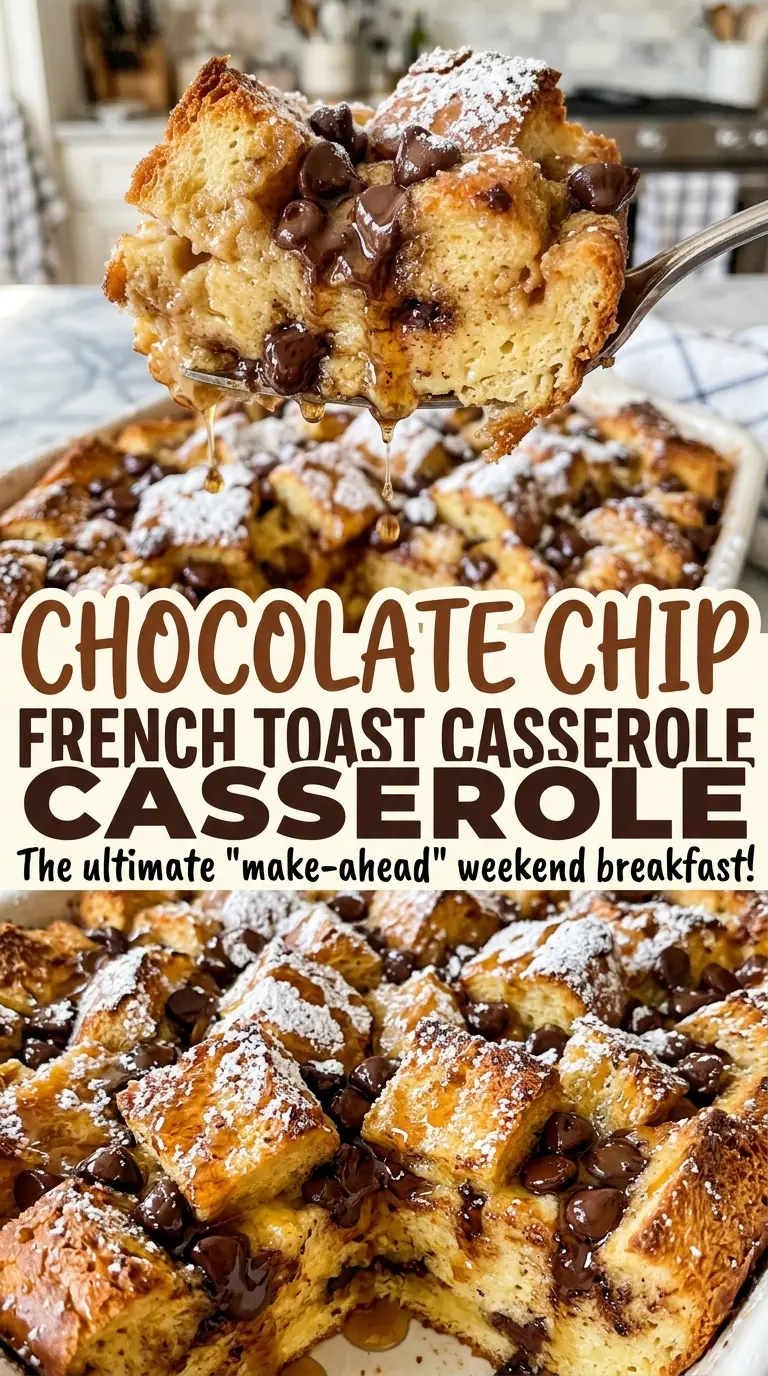
- French bread — Its firm crumb holds its shape as it absorbs the egg mixture, giving you defined pieces rather than a uniform pudding-like texture. A fresh loaf is fine; cut it into even cubes so they soak at a similar rate. A sturdy French-style gluten-free loaf is the closest swap if you need one.
- Semisweet chocolate chips — Their sweetness balances the lightly spiced custard, and chips keep their shape better than finely grated chocolate. A standard grocery-store bag works well here. Bittersweet chips are a useful swap if you prefer a less-sweet bite; chopped bittersweet chocolate will melt into softer streaks.
- Eggs, whole milk, and heavy cream — Eggs give the soaked bread its set structure, while the two dairy ingredients make the custard rich without making it dense. Use large eggs for the intended balance. Whole milk and heavy cream are worth keeping together; replacing both with a single low-fat dairy product changes the casserole’s richness and set.
- Brown sugar, vanilla, and cinnamon — Packed light brown sugar brings a mild molasses note, while vanilla rounds out the chocolate and cinnamon adds warmth. Fresh ground cinnamon makes the most difference; standard vanilla extract is perfectly good, so there’s no need to reach for an expensive bottle.
- Butter for the dish — Softened unsalted butter coats the baking dish and helps prevent the edges from sticking. Spread it into the corners and up the sides; a thin, even coating is all you need.
How to Assemble and Bake the Custard-Soaked Bread
Grease the Dish and Layer the Bread
Coat the bottom and sides of a 9×13-inch baking dish with softened butter. Spread half of the 1-inch bread cubes in the dish, add half of the chocolate chips, then layer on the remaining bread and chips. Keep the bread in an even layer rather than piling it high in the center, so the custard can reach all the pieces. You’ll have a more even bake when the cubes are distributed from corner to corner.
Whisk a Smooth, Even Custard
In a large bowl, whisk together the eggs, whole milk, heavy cream, brown sugar, vanilla, cinnamon, and kosher salt until combined. Scrape the bottom of the bowl as you whisk so no streaks of egg or brown sugar are left behind. Pour the mixture evenly over the bread instead of emptying it in one spot. If you see a dry patch, gently nudge the bread so the liquid can run into that area.
Give the Bread Time to Absorb the Custard
Cover the baking dish and refrigerate it for at least 4 hours or overnight. This rest gives the custard time to soak into the center of the cubes, not just coat their surfaces. The longer chill is handy when you’re planning breakfast ahead, and it means the oven work is all that’s left in the morning. Don’t skip the cover; it protects the bread while the dish rests in the refrigerator.
Bake Covered, Then Uncovered
Take the casserole out of the refrigerator and let it stand at room temperature for 30 minutes while the oven heats to 350°F. Cover the dish with foil and bake for 35 to 40 minutes, then remove the foil and bake for another 20 to 25 minutes. The center should be set and reach 160°F on an instant-read thermometer. Check the middle of the casserole, not a chocolate pocket, so melted chocolate doesn’t give you a misleading reading.
Let the Casserole Rest Before Serving
Once it comes out of the oven, leave the casserole to rest for 10 minutes before serving. The custard continues to settle during this short pause, making it easier to lift portions without the bread sliding apart. If the edges look firm but the center moves loosely when you shift the dish, give the center another temperature check before you rest it. Serve warm, when the chocolate is still soft between the bread cubes.
Three Simple Ways to Adapt This French Toast Casserole
Make the chocolate more bittersweet
Swap the semisweet chocolate chips for the same amount of bittersweet chips. The custard stays the same, but the finished casserole tastes less sweet and the chocolate comes through more strongly. Chopped bittersweet chocolate works too, though it melts into softer ribbons rather than keeping neat chip shapes.
Use a gluten-free French-style loaf
Replace the French bread with a sturdy gluten-free French-style loaf, cut into the same size cubes and measured to the same volume. A loaf with a firm crumb is less likely to break down in the custard; softer gluten-free bread can produce a more delicate, pudding-like center. Check that the chocolate chips and other packaged ingredients meet your needs.
Make a dairy-free version
Use plant-based butter for greasing, unsweetened oat milk in place of whole milk, and an oat-based heavy cream alternative in place of the cream. Choose dairy-free semisweet chocolate chips as well; keep the eggs, brown sugar, vanilla, cinnamon, and salt unchanged. The casserole will still set, though the custard may be a little less rich than the version made with dairy.
Storage and Reheating
- Refrigerator: Store leftovers covered or in an airtight container for 3 to 4 days. The bread softens further as it sits, so the texture will be more custardy than on the first day.
- Freezer: Freeze baked portions in airtight containers for up to 2 months for best quality. Thaw overnight in the refrigerator before reheating.
- Reheating: Warm portions covered in a 325°F oven until the center reaches 165°F, or heat individual portions in the microwave in short intervals until hot throughout. Leaving it uncovered in the oven can dry the top before the middle warms through.
Questions That Come Up When Making This Casserole
Chocolate Chip French Toast Casserole
Ingredients
Equipment
Method
- Grease a 9x13-inch baking dish with the softened butter.
- Spread half the bread cubes in the dish, sprinkle with half the chocolate chips, then add the remaining bread and chocolate chips.
- In a large bowl, whisk the eggs, milk, heavy cream, brown sugar, vanilla, cinnamon, and salt until combined.
- Pour the egg mixture evenly over the bread.
- Cover the dish and refrigerate for at least 4 hours or overnight.
- Let the casserole stand at room temperature for 30 minutes while the oven heats to 350°F.
- Bake covered with foil for 35 to 40 minutes.
- Uncover and bake for 20 to 25 minutes more, until the center is set and reaches 160°F on an instant-read thermometer.
- Let the casserole rest for 10 minutes before serving.