
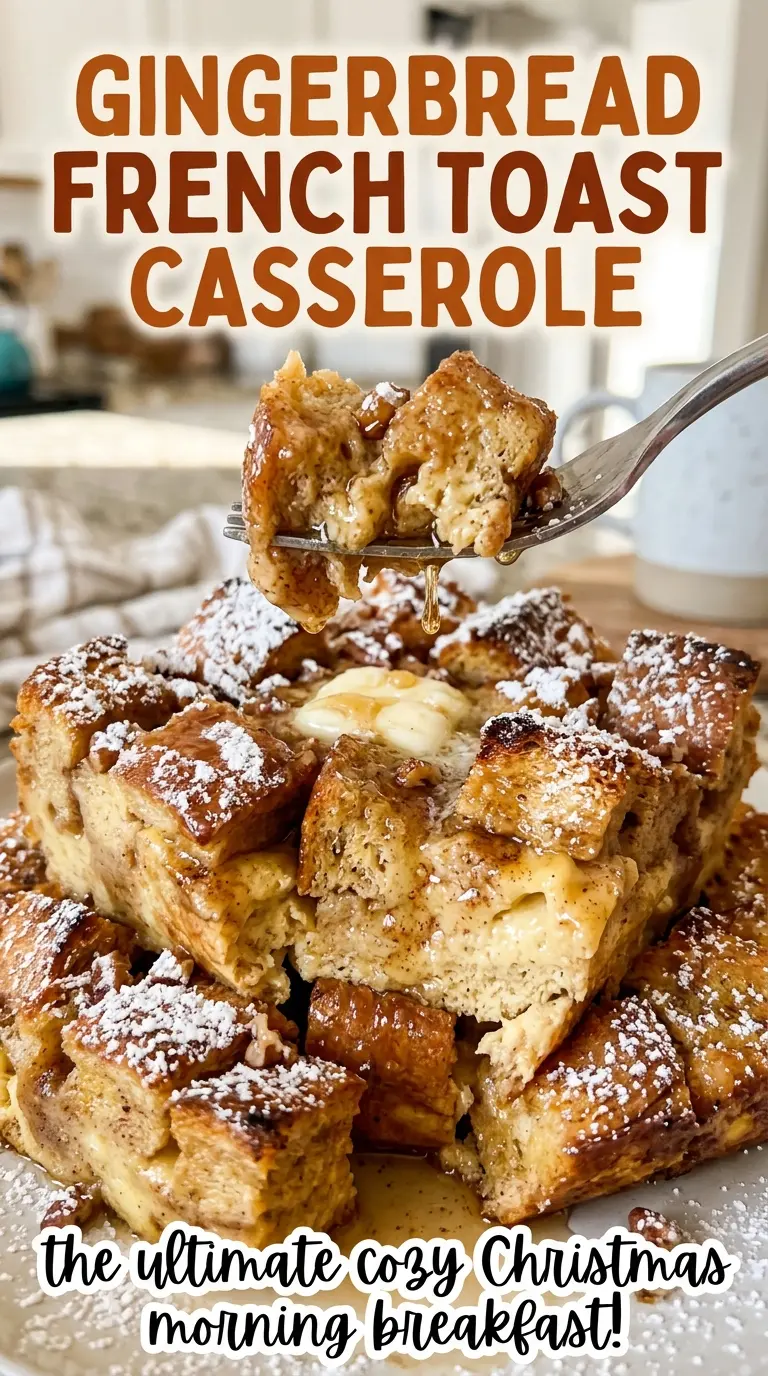
When the custard first hits the bread, the cubes look like they’re floating in far too much liquid. That’s normal. After a long chill, the challah or brioche drinks it in, and this Gingerbread French Toast Casserole bakes up soft in the middle with a warmly spiced top.
I like this make-ahead breakfast because the hands-on part is over the night before. Cut the bread into even cubes, whisk the custard until the molasses and spices are fully blended, then let the refrigerator do the slow work. The ginger, cinnamon, cloves, and nutmeg make the kitchen smell like gingerbread while the casserole bakes, and the brown sugar rounds out the molasses without burying those spices. It’s rich, tender, and easy to portion after a short rest.

Kitchen Note
Give the casserole its full 10-minute rest after baking. The center continues to settle during that time, so the first scoop holds together instead of slumping onto the plate.
Save this Gingerbread French Toast Casserole for a make-ahead breakfast with molasses, warm spices, and a custardy center.
Why the Bread Needs More Than a Quick Dip
French toast cooked slice by slice gets a fast soak; a casserole needs time for the custard to travel into the middle of every cube. That difference matters here because the dish is deeper than a skillet, and the bread is arranged in a single layer rather than dipped and cooked right away. A short soak can leave you with bread that’s custardy around the edges but dry in the center.
Day-old bread helps with that balance. Its drier surface can take up more of the egg mixture without falling apart, while the one-inch cubes leave plenty of edges for the custard to cling to. Keep the cubes similar in size and spread them evenly through the 9×13-inch dish. If some pieces are much larger than others, they won’t soften at the same pace, and the finished casserole will have uneven patches.
The long refrigerator rest also gives the spices and molasses time to mingle through the custard. You’re not looking for a quick coating on the bread; you want the cubes to absorb enough mixture to bake into a cohesive, tender center.
What the Molasses, Bread, and Dairy Each Bring
- Challah or brioche — Both are enriched breads with a tender crumb that soaks up custard without turning tough. Day-old bread is the better choice, but either loaf works; challah is often a little less rich, while brioche gives the casserole a buttery finish. Fresh bread still works, though its softer texture can make the baked center less distinct.
- Unsulphured molasses — This gives the casserole its deep gingerbread character and dark color. Choose unsulphured molasses for a rounded sweetness; blackstrap is much more bitter and can overpower the spices. Pure maple syrup can stand in at the same volume, but the result will taste lighter and less like classic gingerbread.
- Whole milk and heavy cream — Together they make the custard rich without relying on cream alone. If you’re short on cream, use whole milk in its place; the casserole will be less plush but will still set. Two-percent milk can replace whole milk, though the finished custard will be a little less rich.
- Eggs — The eggs are what turn the soaked bread into a set casserole instead of a bowl of soft bread pudding. There isn’t a dependable direct egg-free swap for this custard; a plant-based liquid replacement won’t set the same way.
- Ground spices — Ground ginger leads, with cinnamon, cloves, and nutmeg filling in the familiar gingerbread warmth. Use spices that still smell fragrant when you open the jar. If a jar has lost its aroma, the casserole will taste muted even if you use the same amount.
- Light brown sugar — It adds sweetness and a gentle caramel note alongside the molasses. Dark brown sugar works in its place for a deeper, slightly more molasses-forward taste.
From Cubes to a Set, Spiced Center
Arrange the Bread in an Even Layer
Grease a 9×13-inch baking dish with softened unsalted butter, then arrange the one-inch bread cubes evenly in the dish. Try not to pack them tightly into one corner or leave a broad bare patch. An even layer gives the custard a consistent path through the bread. Day-old challah or brioche is especially helpful because it holds its shape as it absorbs the liquid.
Whisk a Smooth Gingerbread Custard
In a large bowl, whisk the eggs, whole milk, heavy cream, molasses, brown sugar, ground ginger, cinnamon, cloves, nutmeg, vanilla, and kosher salt until thoroughly combined. Molasses can cling to the bowl, so scrape around the bottom and sides as you whisk. The mixture should look evenly brown, with no streaks of egg white or pools of syrup. If the spices sit in dry clumps, keep whisking until they’re dispersed.
Let the Cubes Absorb the Custard
Pour the egg mixture evenly over the bread, then gently press the cubes down so they absorb the custard. Don’t mash them; a light press is enough to bring the upper pieces into contact with the liquid. Cover the dish and refrigerate for at least 8 hours or overnight. When you take it out, the bread should look damp throughout rather than floating in a deep pool of untouched custard.
Bake Covered, Then Uncovered
Heat the oven to 350°F and bake the covered casserole for 30 minutes. Uncover it and continue baking for 20 to 25 minutes, until the center is set and reaches 160°F. The middle shouldn’t ripple like liquid when you gently nudge the dish, and the top will look more baked once it’s uncovered. If the edges look ready before the middle has set, judge the casserole by its center rather than pulling it early.
Easy Ways to Adapt This Gingerbread Casserole
Make It Dairy-Free with Oat and Coconut Milk
Replace the whole milk with unsweetened oat milk and the heavy cream with full-fat canned coconut milk, using the same amounts. The casserole will still bake into a custard, but coconut adds its own mild flavor and the result won’t have quite the same dairy richness.
Use a Sturdy Gluten-Free Loaf
Swap in a sturdy gluten-free brioche-style loaf, keeping the same weight and one-inch cube size. A loaf with a firm crumb will hold together better than soft sandwich bread, though gluten-free pieces may be more delicate when you serve them.
Storage and Reheating
- Refrigerator: Store covered leftovers for 3 to 4 days. The bread softens further as it sits, but the custard stays tender.
- Freezer: Freeze cooled portions tightly wrapped for up to 2 months for best quality. Thaw them in the refrigerator before reheating; the bread may be a little softer afterward.
- Reheating: Warm individual portions in the microwave, loosely covered, until heated through. Avoid prolonged heating, which can make the edges dry and rubbery.
Questions That Come Up Before Baking
Gingerbread French Toast Casserole
Ingredients
Equipment
Method
- Grease a 9x13-inch baking dish with the softened unsalted butter, then arrange the challah or brioche bread cubes evenly in the dish.
- In a large bowl, whisk the eggs, whole milk, heavy cream, unsulphured molasses, packed light brown sugar, ground ginger, ground cinnamon, ground cloves, ground nutmeg, vanilla extract, and kosher salt until thoroughly combined.
- Pour the egg mixture evenly over the bread and gently press the bread down so it absorbs the custard.
- Cover the dish and refrigerate for at least 8 hours or overnight.
- Heat the oven to 350°F.
- Bake the covered casserole for 30 minutes.
- Uncover and bake for 20 to 25 minutes, until the center is set and reaches 160°F.
- Rest the casserole for 10 minutes before serving.