
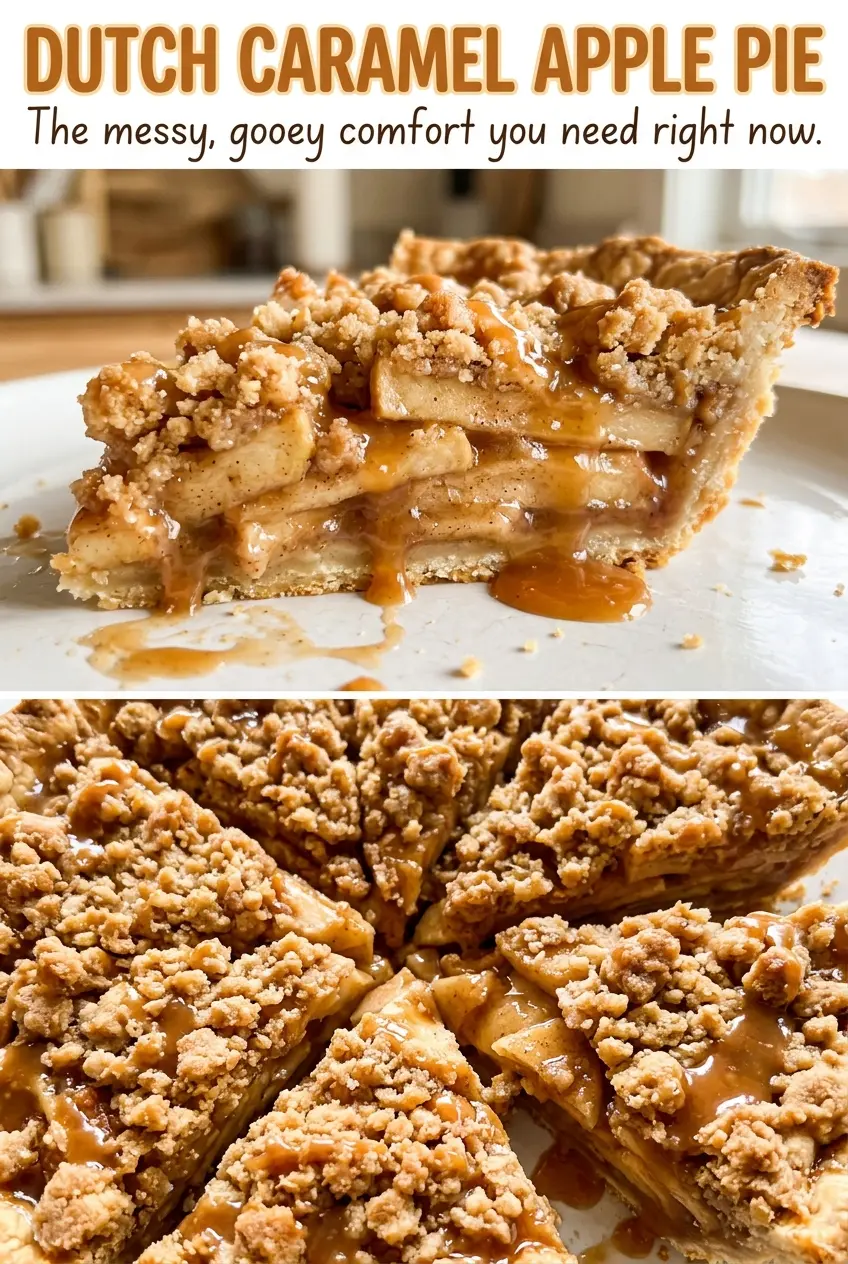
When the pie comes out of the oven, the crumb topping should be golden while the center is still bubbling beneath it. That contrast is what I look for with this Dutch Caramel Apple Pie: tender fruit tucked under a buttery brown-sugar crumble, with caramel added after the pie has cooled. It’s a generous pie, and the filling needs a little patience before it’s ready to slice.
I use firm apples so they soften in the oven without collapsing into applesauce, and cornstarch helps thicken the juices they release. The topping comes together with melted butter, so there’s no need to cut cold butter into flour; stir just until you have coarse crumbs, then scatter them over the fruit. Once the caramel goes on, every slice has a sweet finish over that crisp, crumbly top.
Kitchen Note
Stop stirring the topping as soon as the melted butter turns the flour and brown sugar into coarse crumbs. If you keep mixing, the crumbs can compact instead of scattering lightly over the apples.
Save this Dutch Caramel Apple Pie for a bake with tender apples, a buttery crumb top, and a caramel drizzle added once the filling has set.
Why the Pie Has to Bubble in the Middle Before You Pull It Out
A golden top doesn’t tell you whether the apples in the center are tender. The crust and crumb can brown before the heat has worked through the mound of fruit, especially when the apple slices are piled high. Look for the filling bubbling in the center, and pierce an apple there with a knife. It should feel tender rather than firm or crunchy.
That bubbling matters for the filling, too. The apples release juice as they bake, and the cornstarch needs to get hot enough to thicken that liquid. If the pie comes out as soon as the topping looks done, the fruit may still be firm and the filling may run when you cut it. The two-stage bake gives the crust and topping a head start at 400°F, then the lower 375°F oven gives the apples time to finish. If the topping starts getting too dark before the center is ready, loosely tent the pie with foil and keep baking until the fruit and filling show the right cues.
Firm Apples Keep the Filling From Turning to Applesauce

- Apples — Granny Smith and Honeycrisp bring a good tart-sweet balance, and both stay firm as they bake. Choose apples that feel solid rather than soft or mealy; another firm baking apple can stand in for either variety. Peel, core, and slice them thinly so the pieces soften during the bake.
- Cornstarch and lemon juice — Cornstarch thickens the juices released by the fruit, while lemon juice brightens the filling and slows browning as you mix. Bottled lemon juice works in place of fresh. If you’re out of cornstarch, use twice as much all-purpose flour; the filling will look cloudier and feel a little less glossy.
- Granulated sugar and cinnamon — Granulated sugar sweetens the fruit without adding the molasses flavor that belongs in the crumb topping. Apple pie spice can replace the cinnamon in the filling in the same amount for a broader spice note. Taste and sweetness vary by apple, so the blend of firm varieties is useful when you want both tartness and sweetness.
- Refrigerated pie crust — A refrigerated crust keeps this pie straightforward and fits a 9-inch pie plate. A homemade 9-inch crust works too; keep it chilled until you’re ready to fit it into the plate, then crimp the edge.
- Flour, brown sugar, and butter — All-purpose flour gives the topping its crumb structure, light brown sugar brings a mild molasses note, and melted unsalted butter binds the mixture. Dark brown sugar can replace light brown sugar for a deeper flavor. Use a 1-to-1 gluten-free baking flour for the flour if you’re adapting the crumb; see the variation below for the crust swap as well.
- Caramel sauce — Use a sauce that pours smoothly when warmed, whether it’s store-bought or homemade. If your caramel is especially thick, warm it in short bursts and stir between each one so it loosens evenly instead of overheating around the edges.
From a Crimped Crust to a Set Caramel Finish
Let the Crust Relax Before Fitting It
Heat the oven to 400°F with a rack in the lower-middle position. Let the refrigerated crust stand at room temperature for 15 minutes; it should bend into the plate without cracking. Fit it into a 9-inch pie plate and crimp the edge. If you try to shape it while it’s stiff and cold, cracks are more likely along the rim.
Coat the Apples Evenly
Toss the peeled, cored, thinly sliced apples in a large bowl with the granulated sugar, cornstarch, lemon juice, cinnamon, and kosher salt. Turn the slices until you can’t see dry pockets of starch or sugar clinging to the bowl. Mixing thoroughly now helps the thickener spread through the fruit instead of collecting in a few spots. Keep the slices in the bowl until you’re ready to fill the crust.
Make Crumbs, Not a Dough
Stir the flour and brown sugar together first, then mix in the melted butter. The mixture is ready when it forms loose, coarse crumbs that hold together lightly when pinched. If it looks like smooth dough, it’s been worked more than needed; break it back into small pieces before topping the pie. The scattered pieces bake into a textured layer rather than one dense sheet.
Bake Until the Center Shows You It’s Ready
Pile the apples into the crust and scatter the crumb topping evenly over the fruit. Set the pie plate on a baking sheet to catch any juices that bubble over. Bake for 20 minutes at 400°F, then reduce the oven to 375°F and bake for 40 to 50 minutes. If the topping browns too quickly, tent it loosely with foil; the pie is ready when the topping is golden, a knife pierces tender apples, and the filling bubbles in the center.
Cool Fully, Then Add the Caramel
Set the pie on a rack and let it cool for at least 3 hours so the filling has time to set. Warming the caramel before drizzling makes it easier to control; heat it in a microwave-safe bowl in 10-second bursts, stirring after each burst until it pours. Drizzle it over the cooled pie. Adding it after cooling keeps the caramel on top rather than blending it into the hot filling.
What to Change for a Tarther Pie or a Gluten-Free Crumb
Use All Granny Smith Apples for a Tarther Filling
Use firm Granny Smith apples for the full amount of fruit instead of mixing varieties. The filling will taste more tart and less honeyed than a blend with Honeycrisp, while the apple slices will still hold their shape through baking.
Make the Crust and Crumb Gluten-Free
Choose a 9-inch refrigerated gluten-free pie crust and use a measure-for-measure gluten-free baking flour in the crumb topping. The filling ingredients are naturally gluten-free, but the crumb may be a little more delicate, so scatter it gently rather than pressing it down.
Give the Spice a Broader Note
Swap the ground cinnamon for the same amount of apple pie spice. The added spice notes make the fruit taste warmer and more complex, without changing the filling’s texture.
Storage and Reheating
- Refrigerator: Cover leftovers and refrigerate for 3 to 4 days. The crumb topping softens as it sits.
- Freezer: Freeze the fully cooled pie before adding caramel. Wrap it tightly and freeze for up to 3 months; thaw it in the refrigerator, then warm and add fresh caramel.
- Reheating: Warm slices in a 300°F oven for about 10 to 15 minutes, tenting loosely with foil if the topping is already browned. The microwave is quicker but softens the crumb topping.
Questions About Dutch Caramel Apple Pie
Dutch Caramel Apple Pie
Ingredients
Equipment
Method
- Heat the oven to 400°F with a rack in the lower-middle position.
- Let the refrigerated crust stand at room temperature for 15 minutes.
- Fit the crust into a 9-inch pie plate and crimp the edge.
- In a large bowl, toss the apples with the granulated sugar, cornstarch, lemon juice, cinnamon, and salt until evenly coated.
- Stir the flour and brown sugar together, then mix in the melted butter until coarse crumbs form.
- Pile the apple mixture into the crust and scatter the crumb topping evenly over it.
- Set the pie plate on a baking sheet.
- Bake for 20 minutes at 400°F.
- Reduce the oven to 375°F and bake for 40 to 50 minutes, tenting loosely with foil if the topping browns too quickly, until the topping is golden, the apples are tender when pierced with a knife, and the filling bubbles in the center.
- Cool the pie on a rack for at least 3 hours so the filling can set.
- Warm the caramel sauce in a microwave-safe bowl in 10-second bursts, stirring until pourable.
- Drizzle the caramel sauce over the cooled pie.