
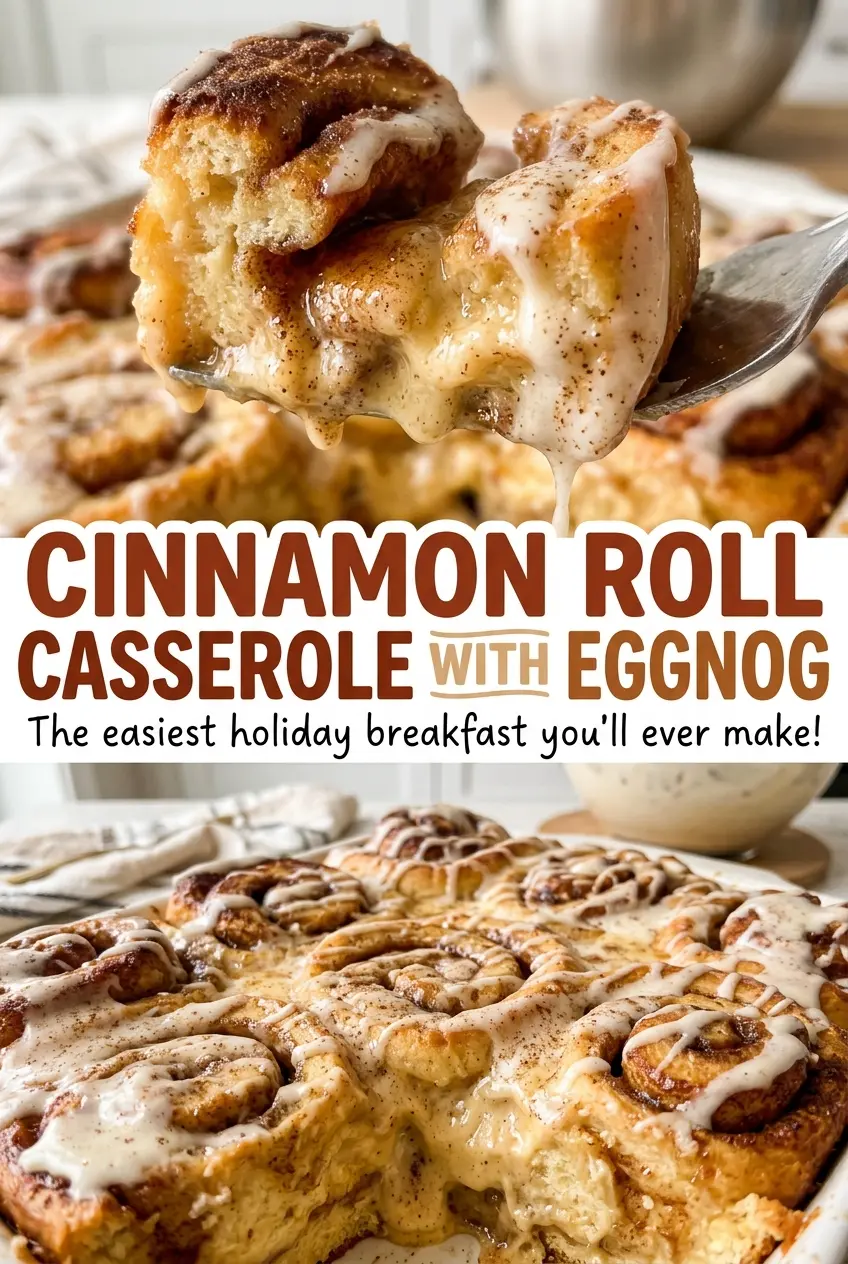
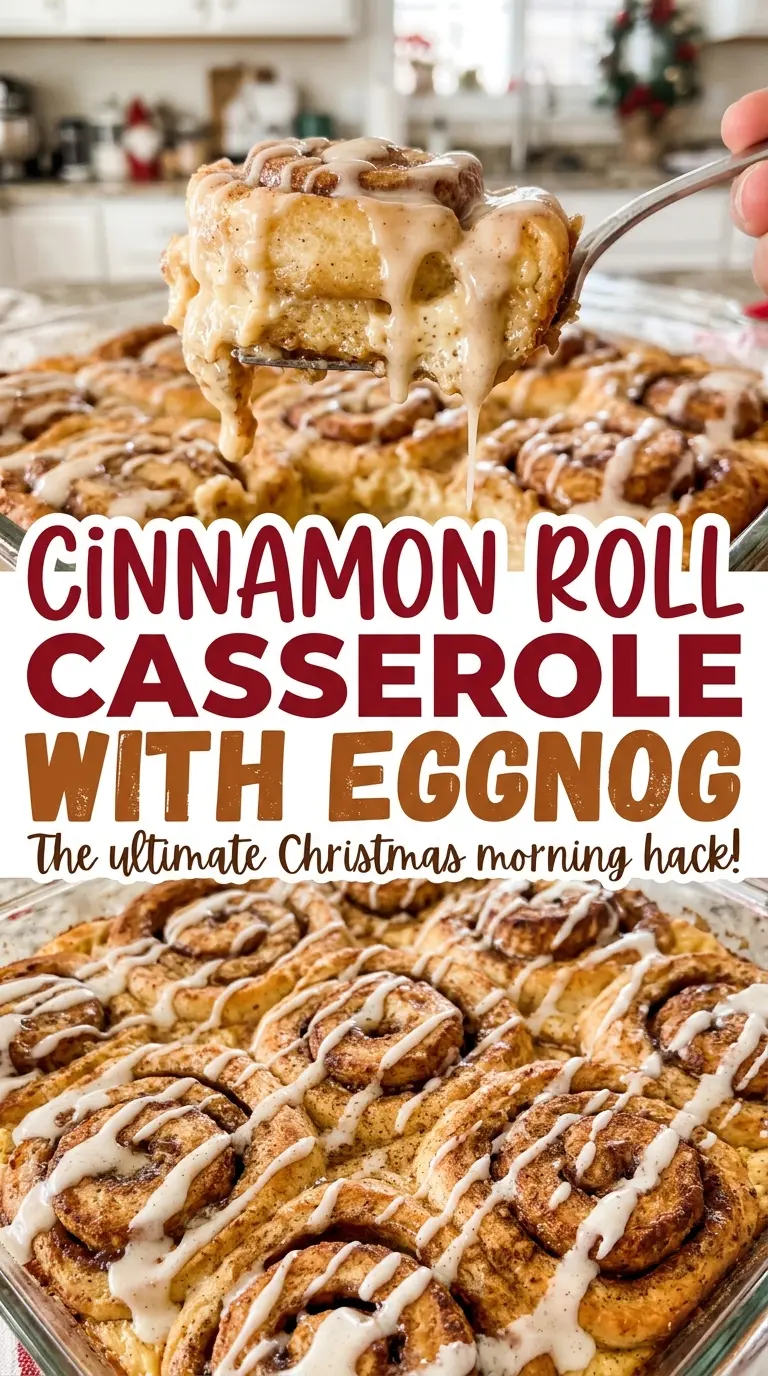
The edges of this casserole turn golden while the cinnamon roll pieces puff up and soak in the eggnog custard. I like that every scoop has a mix of soft, custardy centers and browned tops, with the icing adding a familiar cinnamon-roll finish. This cinnamon roll casserole with eggnog takes refrigerated rolls and turns them into a breakfast bake that feels special without asking you to make dough from scratch.
Cutting the rolls into quarters gives the custard more places to settle than leaving the rolls whole, so you get a tender casserole instead of a layer of dry dough with egg pooled underneath. Eggnog brings sweetness and a gentle spice of its own, while eggs help everything set into neat, spoonable pieces. Let the center finish baking before you add the icing, and the warm drizzle lands on the casserole instead of disappearing into a loose middle.
Kitchen Note
Warm the icing only until it turns pourable; it takes 10–15 seconds in the microwave. I stop as soon as it drizzles easily, since hot icing runs off the tops instead of sitting in soft ribbons.
Save this cinnamon roll casserole with eggnog for a cozy breakfast bake with golden tops, soft custardy centers, and the icing already tucked into the cans.
Why Quartering the Rolls Gives You a Better Custard-to-Dough Balance
Whole cinnamon rolls make a thick layer of dough, and the egg mixture has a harder time reaching the middle evenly. Quartering each roll opens up the pieces so the custard can coat more of their cut surfaces. That helps the bake hold together without turning the top into a dry cap over an under-soaked center.
Spread the pieces across the dish rather than piling them into one mound. The goal isn’t to pack them tightly; leave the cut edges exposed so the eggnog mixture can flow around them. As the casserole bakes, the dough softens and the egg mixture sets, giving you distinct pieces with a tender middle. If you use much larger pieces, the outside can brown before the custardy spaces between them have firmed up. That contrast between exposed, browned tops and soft interiors is what makes this casserole feel like cinnamon rolls and French toast at once.
The eggnog matters here for more than its seasonal flavor. It gives the custard a richer, sweeter base than plain milk, which complements the dough and icing already built into the cinnamon rolls. The warm spices support that flavor without turning the bake into a heavily spiced pudding.
What Eggnog, Eggs, and the Included Icing Each Bring
- Refrigerated cinnamon rolls — The dough gives the casserole its recognizable cinnamon-roll texture, and the included icing makes a ready-made finish. A standard store-brand can works; the important part is using rolls that come with icing packets. Homemade dough absorbs liquid differently, so it isn’t a direct swap for this bake.
- Eggs — Eggs bind the eggnog around the dough and give the center its set structure. There isn’t a dependable egg-free substitute here; replacing the eggs would change the custard rather than simply change its flavor.
- Eggnog — Eggnog supplies sweetness, dairy richness, and a mild spice note in one ingredient. Plain milk won’t give the same body or flavor, so I wouldn’t use it as a one-for-one replacement if you want the casserole to turn out as intended.
- Vanilla extract — Vanilla rounds out the eggnog and cinnamon-roll flavors. Regular vanilla extract is all you need; there’s no reason to use a costly specialty bottle for this baked custard.
- Ground cinnamon and nutmeg — These warm spices reinforce the cinnamon in the rolls and keep the eggnog flavor from taking over. Freshly opened ground spices smell livelier, but ordinary pantry spices work well here. Measure them carefully so the nutmeg stays in the background.
- Icing packets — The included icing is sweeter and thicker than a simple drizzle of sugar, and it ties the casserole back to the rolls. Set the packets aside when opening the cans so they don’t get thrown away with the packaging.
How to Get the Custard Set Without Overbrowning the Tops
Prepare the Dish and Make Even Pieces
Heat the oven to 350°F and lightly coat a 9×13-inch baking dish with nonstick cooking spray. Take the icing packets out of both cans and set them aside. Cut every cinnamon roll into quarters, then spread the pieces evenly in the prepared dish. A crowded pile bakes less evenly, so distribute the pieces across the whole pan.
Whisk and Pour the Eggnog Mixture
In a medium bowl, whisk the eggs with the eggnog, vanilla, cinnamon, and nutmeg until the mixture looks uniform. You shouldn’t see streaks of egg white or clumps of spice. Pour it over the cinnamon roll pieces as evenly as you can, aiming for the gaps as well as the tops. If one area looks dry while another has a puddle, gently redistribute the pieces before the dish goes into the oven.
Bake Until the Center Is Set
Bake uncovered for 35–45 minutes, watching for golden tops and a center that has set. Check the middle with an instant-read thermometer; it should reach 160°F. If the tops brown before the center is ready, loosely cover the dish with foil and continue baking until the center reaches temperature. Let the casserole rest for 10 minutes, then warm the reserved icing in a small microwave-safe bowl until pourable and drizzle it over the top.
Three Small Changes That Give This Casserole a Different Finish
Go Lighter on the Icing
Drizzle only part of the icing over the finished casserole and save the rest for another use. The cinnamon rolls still bring plenty of sweetness, while the lighter topping lets the eggnog and warm spices come through more clearly.
Make the Spice Milder
Leave out the ground nutmeg for a softer, more straightforward cinnamon flavor. The custard still sets the same way, but the eggnog’s own spice and the cinnamon-roll filling take the lead.
Use Dairy-Free Eggnog
For a dairy-free version, replace the eggnog with the same amount of a pourable dairy-free eggnog. The eggs remain in the casserole, so this is dairy-free rather than egg-free or vegan. The result may taste a little lighter, depending on the brand you use.
Storage and Reheating
- Refrigerator: Cover leftovers and refrigerate them for 3–4 days. The dough softens as it sits, so the pieces will be less distinct than when freshly baked.
- Freezer: Freeze cooled portions in airtight containers for up to 2 months. Thaw them in the refrigerator before reheating; the texture will be softer after freezing.
- Reheating: Warm individual portions in the microwave until hot throughout, or cover the baking dish with foil and reheat it in a 350°F oven. Avoid leaving the casserole uncovered for a long reheat, which can dry out the exposed tops.
Questions I Get Asked About This Eggnog Cinnamon Roll Bake
Cinnamon Roll Casserole with Eggnog
Ingredients
Equipment
Method
- Preheat the oven to 350°F and lightly coat a 9x13-inch baking dish with cooking spray.
- Remove the icing packets from the cinnamon roll cans and set them aside.
- Cut each roll into quarters.
- Spread the cinnamon roll pieces evenly in the baking dish.
- Whisk the eggs, eggnog, vanilla, cinnamon, and nutmeg in a medium bowl until combined.
- Pour the eggnog mixture evenly over the cinnamon roll pieces.
- Bake uncovered for 35-45 minutes, until the tops are golden and the center is set and reaches 160°F on an instant-read thermometer; loosely cover with foil if the tops brown before the center is done.
- Let the casserole rest for 10 minutes.
- Microwave the icing in a small microwave-safe bowl for 10-15 seconds, until pourable.
- Drizzle the icing over the casserole.