
The mushrooms shrink as they cook, and at first the skillet looks far too wet for anything destined to sit inside puff pastry. Keep stirring and give them time; when the pan finally looks dry, you’ve got a savory filling instead of a soggy one. That’s the small kitchen moment that makes these Christmas Eve Chicken Wellingtons feel manageable rather than fussy.
I like that the filling and chicken cool completely before they meet the pastry. It gives me time to work neatly, and the thawed pastry stays easier to handle while I seal each parcel. The layers are simple: prosciutto around the mushroom filling and chicken, then golden pastry around everything.
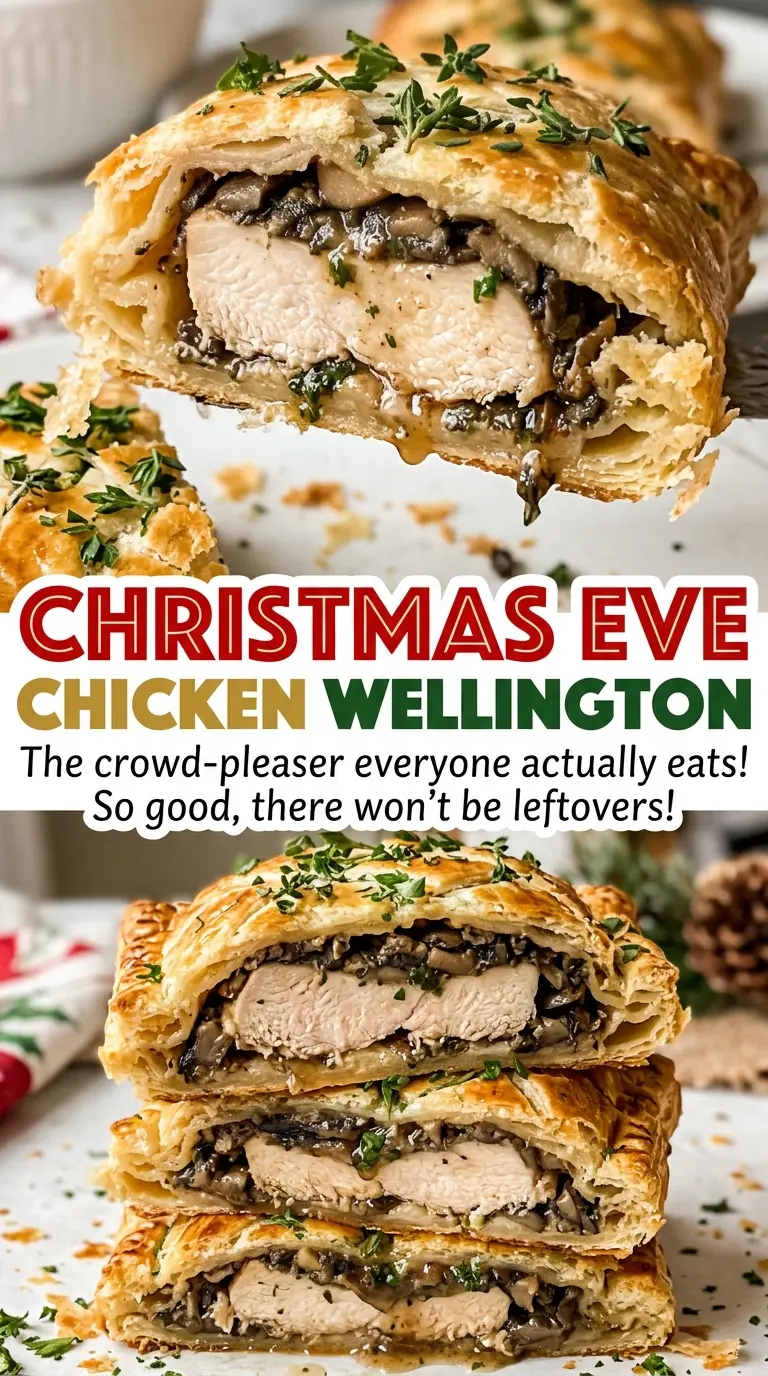
Each Wellington comes out as its own crisp, flaky parcel, with a tender chicken center and a deeply browned top. Let the crust be the first thing you notice when you set one on the table.

Kitchen Note
Brush the beaten egg over the pastry tops in an even coat, and keep it from pooling at the sealed edges. A puddle can glue the layers together instead of letting them lift and turn flaky.
Save these Christmas Eve Chicken Wellingtons for a special dinner with crisp pastry, savory mushroom filling, and individual chicken parcels.
Why Thin Cutlets Keep the Chicken and Pastry on the Same Schedule
A thick chicken breast takes longer to cook through than a cutlet, and that mismatch matters inside a pastry parcel. The pastry needs enough oven time to turn deeply golden, while the chicken center needs to cook through without the outside of the Wellington getting too dark. Pounding each cutlet to an even half-inch thickness helps those two things happen on a similar schedule.
It also gives each parcel a flatter, more even center, so the prosciutto and mushroom filling can wrap around the chicken instead of creating a bulky lump. Use cutlets in the specified size range and pound them evenly rather than leaving a thick end. If a parcel’s pastry browns before its chicken is done, a loose foil tent lets the chicken keep baking without letting the top get too dark.
What the Mushroom, Prosciutto, and Pastry Each Bring
- Cremini mushrooms — Their earthy flavor stands up to the chicken and prosciutto. Chop them finely so the filling stays together in a thin layer; white button mushrooms work as a one-for-one substitute, though their flavor is milder.
- Prosciutto — Thin slices bend around the filling without making a bulky seam, and their saltiness seasons the mild chicken. If you can’t find prosciutto, thinly sliced deli ham can wrap the filling; it will be less delicate, so overlap the slices carefully.
- Chicken breast cutlets — Boneless, skinless cutlets keep the center lean and let the mushroom and mustard come through. Look for pieces that are similar in size so the individual parcels bake evenly.
- Dijon mustard — Its sharp, tangy bite cuts through the buttery pastry and savory filling. Whole-grain mustard can stand in at the same amount for a softer, more textured mustard layer.
- Frozen puff pastry — The two-sheet frozen package gives you pastry that puffs into distinct, flaky layers. Thaw it according to the package directions; pastry that’s still stiff can crack when folded, while pastry that gets warm is harder to seal neatly.
- Fresh thyme — Fresh leaves bring a gentle herbal note to the mushrooms. Dried thyme works in a pinch, but use less than the fresh amount because its flavor is more concentrated.
From Dry Mushroom Filling to Deep-Golden Pastry
Cook the Mushrooms Until the Skillet Is Dry
Melt the butter in a 12-inch skillet over medium heat and cook the chopped shallot for 2 minutes. Add the finely chopped mushrooms and fresh thyme, then cook for 10 to 14 minutes, stirring often. The mushrooms will release liquid before it evaporates; keep cooking until the pan is dry. Transfer the mixture to a plate and let it cool completely before assembling.
Season, Sear, and Cool the Chicken
Season the cutlets with kosher salt and black pepper. Heat the olive oil in the same skillet and sear the chicken in batches for about 2 minutes per side, just until lightly browned. The cutlets finish cooking inside the pastry, so this quick sear is for color rather than a fully cooked center. Move them to a clean plate and let them cool completely.
Wrap Each Filling in Pastry
Heat the oven to 400°F and line a rimmed baking sheet with parchment paper. Cut each pastry sheet in half to make four rectangles measuring 5 by 10 inches. For each parcel, overlap two slices of prosciutto, spread one-quarter of the mushroom mixture in the center, brush a chicken cutlet with Dijon, and set it on top; wrap the prosciutto around the filling. Place the bundle on one half of a pastry rectangle, fold the other half over, and press the edges firmly to seal.
Bake Until the Pastry Is Golden and the Chicken Is Done
Set the Wellingtons seam-side down on the prepared baking sheet and brush the tops with the beaten egg. Bake for 25 to 30 minutes, until the pastry is deep golden brown and the center of each cutlet reaches 165°F. If the pastry browns before the chicken is done, tent it loosely with foil and continue baking. Rest the Wellingtons for 5 minutes before serving.
Simple Swaps for Different Dietary Needs and Mustard Fans
A dairy-free Wellington
Use olive oil in place of the butter when cooking the shallot and mushrooms, and choose dairy-free frozen puff pastry. The filling will lose a little buttery richness, but the thyme, mushrooms, prosciutto, and mustard still give it plenty of savory character.
A gluten-free pastry swap
Use a gluten-free puff pastry that comes in sheets and can be cut into four parcels. Follow its package directions for thawing and handling; the pastry may be more delicate and less lofty than standard puff pastry, but it still makes an enclosed Wellington.
A more textured mustard layer
Swap the Dijon for the same amount of whole-grain mustard. Its mustard seeds add a little texture and a gentler tang, while still giving the chicken a bright layer beneath the prosciutto.
Storage and Reheating
- Refrigerator: Store leftovers in an airtight container for 3 to 4 days. The pastry softens as it sits.
- Freezer: Freeze fully cooled Wellingtons individually, wrapped airtight, for up to 2 months; the crust may be less crisp after thawing.
- Reheating: Reheat in a 350°F oven until hot through. The oven brings back more crispness than a microwave, which tends to soften the pastry further.
Questions That Come Up When Making Chicken Wellington
Christmas Eve Chicken Wellington
Ingredients
Equipment
Method
- Melt the unsalted butter in a 12-inch skillet over medium heat, add the shallot, and cook for 2 minutes.
- Add the cremini mushrooms and fresh thyme leaves and cook for 10 to 14 minutes, stirring often, until the mushrooms release their liquid and the pan is dry.
- Transfer the mushroom mixture to a plate and cool completely.
- Season the chicken breast cutlets with the kosher salt and black pepper.
- Heat the olive oil in the skillet and sear the chicken in batches for about 2 minutes per side until lightly browned.
- Transfer the chicken to a clean plate and cool completely.
- Heat the oven to 400°F and line a rimmed baking sheet with parchment paper.
- Cut each puff pastry sheet in half to make four 5x10-inch rectangles.
- For each Wellington, overlap 2 slices of prosciutto and spread one-quarter of the mushroom mixture over the center.
- Brush a chicken cutlet with Dijon mustard, set it on top of the mushroom mixture, and wrap the prosciutto around the filling.
- Place each bundle on one half of a puff pastry rectangle, fold the other half over, and press the edges firmly to seal.
- Place the Wellingtons seam-side down on the baking sheet and brush the tops with the beaten egg.
- Bake for 25 to 30 minutes, until the pastry is deep golden brown and the center of each chicken cutlet reaches 165°F; if the pastry browns before the chicken is done, tent it loosely with foil and continue baking.
- Rest for 5 minutes before serving.